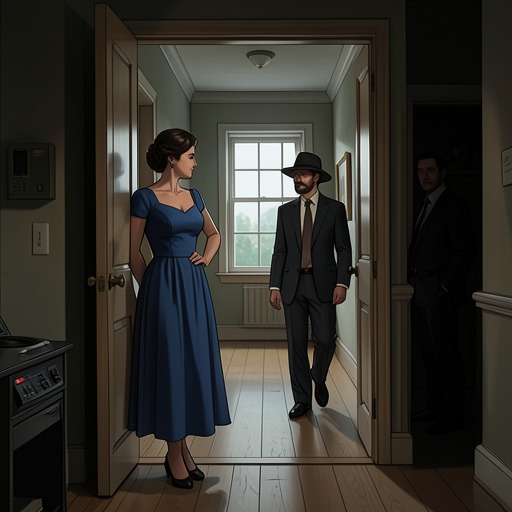
Millie Cronquebil
Poor ThingsMillie Cronquebil is the manager of the Hôtel de Notre-Dame in Paris, a hotel whose cramped reception and carefully priced rooms introduce her as both a capable businesswoman and an unusually frank observer of love, money, and loneliness. She gives Bella Baxter immediate shelter and, when Bella begins to disclose what she witnessed in Alexandria, the encouragement to continue. Millie’s own story complicates that generosity: she has built a life in Paris but longs to return to England, and the business that supports her also seems to keep her trapped.
Identity and Background
When Bella enters the hotel, she finds a small foyer nearly divided by a heavy mahogany desk. Behind it sits Millie, neat, plump, alert, and dressed in black silk like a widow. Her welcoming manner is practical rather than ceremonious. She asks what Bella needs, establishes how little money and luggage she has, and explains the price of a cubicle with precision: twenty francs for the first hour, payable in advance, and another twenty for every additional hour or fraction, due before either party leaves.
Millie presents herself as a Londoner whose first name was Millicent Moon and whose home was Seven Dials. She says that London regulations made it difficult for beginners to enter the hotel trade, so she came to Paris, where new hoteliers had more opportunity. At the Notre-Dame she began in a subordinate position, but became indispensable to the manager, who married her. She later took over management after the Franco-Prussian war, when the Communards had suspended her husband from a lamp bracket because of his international sympathies. Her account is both a personal history and a professional one: each change in her circumstances is tied to work, opportunity, or the loss of the person who had employed her.
Manager of the Hôtel de Notre-Dame
Millie’s hotelkeeping depends on quick judgment and a working knowledge of what guests can afford. Bella asks for the smallest and cheapest room because she has little money and is trying to look after Duncan Wedderburn. Millie offers a cubicle that has just become available, but it will not be ready for ten or fifteen minutes. Rather than leave Bella waiting alone, she invites her to have coffee. The hotel is a place of paid rooms and strict timing, yet its manager makes room for a conversation that is not part of the stated transaction.
Her later explanation of the business makes that transaction look less secure for the person running it. The hotel’s earnings must cover rent, rates, gas, furnishings, wages, and police bribes, as well as a fifteen-per-cent profit for the lawyer acting for the company. If the monthly return falls below that figure, Millie says, she will be replaced immediately. The list gives material shape to her vulnerability: she is the manager, but her position depends on an accounting threshold set for someone else’s benefit. The ease with which she describes French and British people, by contrast, is a form of authority she can claim for herself. She considers the French more sensible about what matters, while calling the British eccentrics beneath their claims to honesty and practicality.
Bella’s Confidante
Millie’s most important act of kindness begins when her banter gives way to concern. She and Bella have been talking about money and love, and Bella says she is afraid to explain what she means by people loving cruelty. Millie stops being merely jolly and asks, quietly, whether a man has hurt her. Bella says that no one has hurt her, but that she is speaking of worse things. Trembling and beginning to weep, Bella takes Millie’s hands; the contact gives her enough strength to describe what happened in Alexandria.
The scene Bella recounts is one of public cruelty: well-dressed diners watch poor children scramble for coins, while men with whips drive them apart. Bella sees a blind girl carrying a blind baby and crosses into the crowd, intending to give them money. Her purse is snatched before she can place it in the girl’s hand. Millie is not a witness to the events in Alexandria; she is the listener before whom Bella can bring them into words. Bella says that she still does not know what to do and that she must return to God for advice, but first she has to deal with the man waiting outside. Millie responds by offering the ready apartment and urging her to take Duncan upstairs and put him to bed, so that the two women can talk again. Her joking phrase about getting rid of him briefly puzzles Bella, but the offer itself is direct: Millie wants to remain with her and provide the counsel of a trusted, experienced woman.
That offer does not depend on Duncan staying. When Bella goes out to fetch him, she finds four empty glasses and an unpaid waiter, but Duncan has vanished. Millie welcomes her back inside and makes more coffee. She then asks how Bella came to be wandering in Paris with so little luggage. Their conversation moves from a commercial arrangement toward personal confidence, though Millie’s practical hospitality remains present throughout.
Precarity and Loneliness
Later, Millie explains that the strain of the hotel business has not brought her the freedom she expected. Although she is plump and queenly in appearance, she begins to wail like a thin child. Bella tries to comfort her with coaxing, kisses, and embraces, but nothing lifts her mood. Millie says that she hates Paris and the French and has spent years hoping to return to England. Her dream is to buy a boarding-house in Brighton and, in the end, receive a proper Church of England funeral.
She believes that every time she saves a little money, an accident takes it away. If she never escapes, she fears her body will end on a slab in the public morgue by the Seine, her makeup running under drops from a rusty tap. The grotesque precision of the imagined ending makes her despair sound at once theatrical and deeply concrete. Her desired return is modest: not wealth or public recognition, but a business of her own in England and a respectable burial. Yet even this prospect remains out of reach because the money she needs can disappear as quickly as it is earned.
Millie also understands herself through her place in Bella’s affections. She laments that she comes fifth, after Bella’s mysterious guardian, her peasant fiancé, Duncan, and the frigid Harry Astley. Since childhood, she says, she has prayed for a friend, only to have beautiful and friendly people leave her with nothing. Bella counters that no god could hate her and tells her to remember their loving embraces rather than imagined owls; she promises that she will always remember Millie with love. Millie’s final question is practical as well as hopeful: whether Bella has earned enough for a third-class fare back to Scotland. Even in distress, she returns to the problem of money that governs both her business and the future she wants.